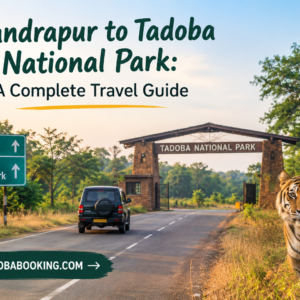

If you have ever been part of a tiger safari and come back empty-handed, you know exactly how that feels. That disappointment is almost impossible in Tadoba. Visitors who come here with zero safari experience still manage to see a tiger sitting near a waterhole or crossing the trail in broad daylight. This does not happen by luck. There are real, specific reasons why Tadoba National Park gives you the highest tiger sighting rate in Maharashtra and this blog breaks them down clearly.
What Makes Tiger Sighting Possible in the First Place
Before anything else, let us understand what actually controls whether you see a tiger or not during a safari.
Three things matter most: how many tigers are in the area, how open the forest is, and whether you can predict where the tiger will go. Tadoba scores high on all three. That is the core reason why tiger sighting chances in Tadoba are higher than in any other wildlife reserve across Maharashtra.
Tiger Population That Actually Lives Here
Tadoba Andhari Tiger Reserve covers 1,727 square kilometres in the Chandrapur district of Maharashtra. As of recent counts, it is home to over 100 Bengal tigers across its core and buffer zones.
But raw numbers are not the full picture. What matters more is density in accessible areas. The core zones — Moharli, Kolara, Navegaon, and Pangadi-Zari — hold some of the highest tiger concentrations in the country. These are also the zones where safari vehicles are permitted to go.
More tigers in accessible zones = more sightings. Simple math, but most reserves do not have this combination.
Also Read: Tiger Population Growth in Tadoba Andhari Tiger Reserve – Conservation Success
The Forest Type Works in Your Favour
This is the factor that most people overlook.
Famous parks like Corbett or Kaziranga also have high tiger numbers. But those parks have tall elephant grass and dense riverine forest. A tiger can be sitting 40 metres away from you and you will never know. The grass hides everything.
Tadoba is a dry teak and bamboo forest. In summer — which is also peak safari season the canopy thins out significantly. Undergrowth drops. The forest becomes readable. You can see through the trees at a distance, and that changes the entire sighting equation.
This is why the Tadoba tiger sighting percentage during peak season regularly crosses 70 to 80 percent — a figure that very few reserves anywhere in the world can match consistently.
Waterholes Are the Secret Weapon
During the hot months between March and June, Tadoba’s waterholes become the most predictable spots in the entire forest. As temperatures go past 40°C, both prey animals and tigers are forced to come to water — not once, but multiple times a day.
Tadoba has several permanent water bodies: Tadoba Lake, Telia Lake, Andhari River, and Irai Lake. Safari routes are designed around these waterholes. Experienced guides and naturalists know exactly which waterhole is active and at what time of day.
This predictability is what separates Tadoba from other forests. You are not randomly searching a 1,700 sq km jungle. You are positioning yourself near a waterhole at the right hour and waiting. The tiger almost always comes.
Resident Tigers Who Have Fixed Territories
One reason repeat visitors book Tadoba again and again is because the tigers here are well-documented. Many of them have names — Maya, Sonam, Choti Tara, and others. These are resident tigers with established territories that safari guides know well.
When you have a tigress who has lived in the same four-kilometre zone for years, and you know her movement patterns, water sources she prefers, and times she is most active — tiger sighting stops being a gamble and starts being a planned encounter.
This is why you will hear people say: “I did not just see a tiger. I saw Maya.” That level of familiarity with individual animals is unique to Tadoba.
Safari Zones That Cover Different Terrains
Tadoba has multiple safari zones across its core and buffer areas. The main ones are Moharli, Kolara, Navegaon, Pangadi, and Zari — each accessed through separate gates.
Moharli and Kolara core zones are known for the highest success rate for tiger sighting. They have dense tiger territories, well-maintained tracks, and experienced naturalists who know every corner.
Navegaon and the buffer zones like Agarzari, Junona, and Adegaon offer a quieter experience with equally strong sighting records, especially for those who do not get a core zone permit.
Because the reserve operates across this many zones, even if one area has low activity on a particular day, another zone may deliver a sighting within the first 30 minutes of the safari. This distribution of chances is something smaller reserves simply cannot offer.
What Season Gives You the Best Tiger Sighting Chances
February to June is when Tadoba is at its absolute best for seeing tigers.
March, April, and May are the peak months. Water becomes scarce, animals cluster near known sources, and the forest floor is clear. A morning jeep safari during this window in Tadoba is as close to a guaranteed tiger sighting as wildlife can offer.
October to February is also good for a comfortable safari experience, with pleasant weather and good sighting rates.
Tadoba closes from July to September for the monsoon season.
If you are planning a Tadoba jungle safari specifically to see tigers, April and May give you the strongest odds. Book well in advance — at least 90 to 120 days before your date because permits sell out fast during this window.
Decades of Conservation That Actually Worked
None of this would be possible without the conservation work that began here decades ago. Anti-poaching efforts, village relocation programs, buffer zone management, and Project Tiger funding have all contributed to a healthy, growing tiger population.
Since Tadoba Andhari Tiger Reserve was officially formed in 1995 after merging Tadoba National Park and Andhari Wildlife Sanctuary, the forest has been managed with a single, unified authority. That consistency in management has made a visible difference over the years — in both tiger numbers and overall wildlife health.
The buffer zone alone now holds 36 tigers as active residents, not just animals passing through. The entire reserve is a functioning wildlife habitat, which shows in the sighting records season after season.
How to Book a Tadoba Safari
Gypsy safaris in Tadoba run in two slots — morning and evening. Each safari is guided by trained forest staff. You can book for safari seats, zone selection, and resort stays all in one place.
If you are visiting for the first time, the Moharli or Kolara core zone gives you the best starting point. If you are a return visitor looking for something off the usual path, the buffer zones are worth exploring.
FAQs
No safari can guarantee a sighting, but Tadoba has a 70 to 80 percent sighting success rate during peak season, which is among the highest in India.
Moharli and Kolara core zones have the highest success rates. Navegaon and Agarzari buffer zones are also strong options.
Tadoba currently has over 100 Bengal tigers across its core and buffer zones.
March to May is the best window. Waterholes concentrate tiger movement, and the open forest makes spotting much easier.
Yes. Buffer zones have active resident tiger populations and often deliver sightings equal to or better than core zones on certain days.
Tadoba has the highest tiger density, most predictable waterhole activity, and the most open forest terrain among all wildlife reserves in Maharashtra.
Conclusion
Tadoba does not rely on one single factor to deliver high tiger sighting rates. It is the combination of a strong resident tiger population, open dry forest terrain, predictable waterhole behaviour, experienced guides who know individual tigers, and decades of solid conservation work — all coming together in one reserve.
If you want to see a Bengal tiger in the wild in Maharashtra, Tadoba Andhari Tiger Reserve is not just your best option. It is the only option that makes sense.